
Being a founder means navigating a stream of complex, high-stakes problems - most of which have no obvious solution. Every day, you and your cofounder are making judgment calls about what to build, how to build it, when to ship, and where to focus. And because you're different people with different experiences, instincts, and perspectives, you'll often approach the same problem with different ideas about how to solve it.
Founders experience those differences as tension - the felt experience of differences between you and who you’re building with. Most of the time, tension is slight and hardly noticeable. If you feel it at all, you usually let it pass and move on. But sometimes the stakes feel high enough or you believe strongly enough in your position - or your cofounder’s approach diverges so much from yours - that you’ll do something about the tension. You’ll try to eliminate it - by closing the distance between you and your cofounder’s perspective.
Put differently: You pull.
When you notice your cofounder is operating differently than you would - making a different choice, a different tradeoff, or focusing where you wouldn’t - most founders’ instinct is to tug them closer to your position so they’ll operate instead as you would. But your cofounder has their own perspective, their own instincts, their own reasons. And they’ll experience your tug as pushing. So they pull back.
The Tension Tug of War has begun.
At first, the Tension Tug of War looks like any normal disagreement. You offer your evidence and make your case - genuinely, because you believe you're right. And your cofounder does the same - genuinely, because they believe they are too. But in your body, something hardens when neither of you moves. The tension that felt loose and uncertain clenches up. In a startup where everything already feels fragile, being pulled away from what you know will work feels more than just a disagreement - it feels like a threat. So you tighten up and pull harder. And so does your cofounder.
The original topic starts to recede. What began as an honest and open conversation about a decision has become something else. Now you're defending your experience. Your instincts. Your role and value as a cofounder. And so is your cofounder - from exactly the same place of certainty and fear. The conversation is no longer about whether to ship quickly or keep testing. Instead you both feel like you're arguing about which one of you is going to kill the company fastest.
This is where the Tension Tug of War does real damage. Because the tension underneath it all - the actual difference between you and your cofounder’s perspective that needed naming and understanding - is never touched. You may have come close enough to reach a decision and settle the surface argument, but the Tension Tug of War has added relational damage underneath it - things said in heat instead of honesty, assumptions that have hardened into mistrust, and more distance between you. The next time tension rises, you'll both be pulling from a distance that’s grown wider and a position that's a little more loaded than before - for each of you.
Tension can help
That damage is completely avoidable - and there’s a healthy way to handle tension. The Tension Tug of War treats differences as threats to eliminate. But differences are natural and inevitable - and they can be an asset if you know how to treat them.
Having multiple perspectives gives founding teams more surface area to find the best solution. The founder who prioritizes speed will see things that the founder who prioritizes quality will miss - and vice versa. An early-stage startup closing its first enterprise customer might be better served by leading with quality - because that kind of customer will pay close attention and a rough user experience could cost the deal. An early consumer product might need the opposite - to ship fast and polish later so your cycles of learning and iteration are quick.
One tension that often causes stress is between growth and reliability. The CEO owns sales and usually holds the urgency to close more deals, drive more revenue, and keep the momentum going. The CTO is usually feeling the weight of what's already been promised, and is responsible for making sure the product can actually serve the customers you already have, let alone the new ones being added. Even a CTO who genuinely values growth can find themselves pushed into defending reliability simply because someone has to - and the CEO doesn't seem to be.
No one is wrong in any of these situations. There are simply two people holding different but necessary parts of the whole. The question isn't whose perspective is right — it's whose perspective is more useful right now, for this decision, and this user, at this stage. Throttling growth to focus on reliability might be exactly right for a month - until the architecture is resilient enough for the product to scale. Then the calculus shifts. The best founding teams don't eliminate their differences. They learn to read the moment and choose consciously which perspective to lead with.
The key word is consciously. Differences that are named and understood can be deliberately applied to the decisions that need them most. Tension that goes unnamed gets acted out - in the Tension Tug of War, in relationship debt, or in a slow degradation of trust.
You can milk the benefit of your differences by mapping them before the tension rises. Here’s an exercise to help you do exactly that:
The exercise: Stretch out your tension
Do this with your cofounders. Set aside thirty minutes, sit down together, and look at this diagram:
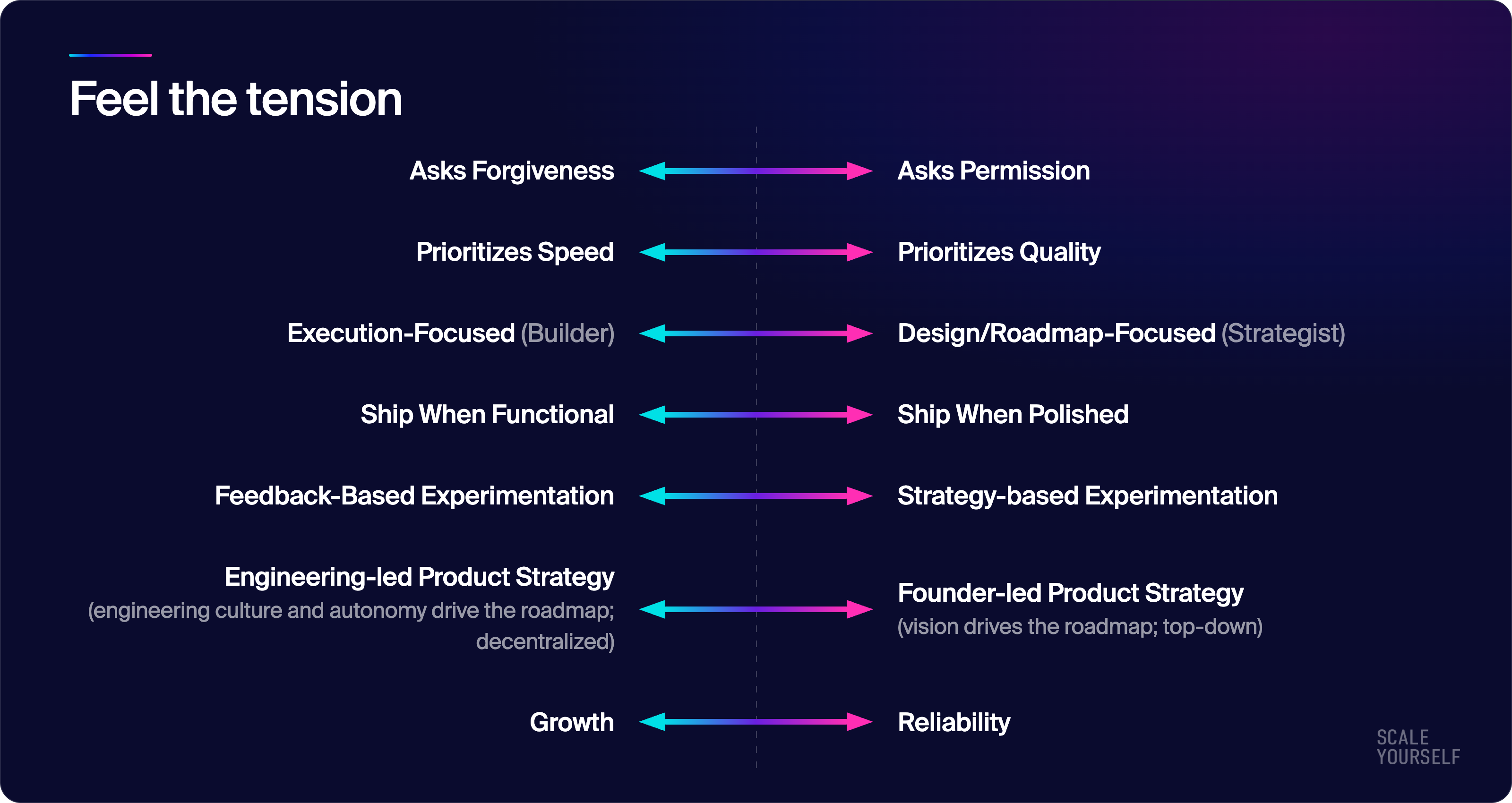
For each spectrum, mark where you each tend to land. Be honest. The further apart you are on any given line, the more tension you're likely to feel — and the more frequently.
Then go beyond the diagram. What other tensions do you experience that aren't shown here? Can you articulate them as spectrums — where you each hold opposing ends? Name them.
Once you've located yourselves, talk about it. You can use these questions to guide the conversation:
To understand your positions more deeply:
- Why am I where I am on this spectrum? What's important to me about this approach? What am I trying to protect or optimize?
- What do I see that my cofounder might be missing or deprioritizing?
- What is my cofounder trying to protect or optimize from their end? What does my cofounder see from their end that I might be missing? What might they be right about?
On communicating well:
- When does this tension typically come up for us? How do we typically handle it? Does that work for us? Does it work for our users/team?
- Which of these tensions has been the hardest to navigate? Why?
- When have we felt it in the past - how did we handle it? Did we handle it well, or would we do it differently now?
- What can we each do differently the next time this tension surfaces, before it becomes a fight?
- The next time I feel tension about this, I request that you… (name an action that will build trust).
On making the decision:
- What’s true about our current stage, our users, our constraints, or our strengths right now that might make one perspective more useful than the other?
- What would it cost us to lead with my cofounder's perspective here instead of mine - and what might we gain?
- How will we know if the perspective we chose was the right one? What does success look like, and when do we check in?
- Can we agree on a timeframe to try one approach — and a specific moment to revisit whether it's working?
The goal of this conversation isn't to resolve your differences or convince your cofounder you’re right. You won't, and you don't need to. The goal is to relax your end of the rope. Let it drop. And look to your cofounder with curiosity instead. Depersonalize your experience of tension - learn to see each position not as a threat but as a perspective your startup (and users) are lucky to have. Ideally, you'll leave this conversation with a clearer map of where your differences are, a genuine curiosity about what your cofounder sees that you don't, and a shared language to make conscious choices about whose perspective to lead with - and when, and why.
Tension between you and your cofounder is not a sign that something is wrong. It's a sign that you're different people - which is exactly why you decided to build together in the first place.
Going forward, expect tension. Get curious and talk about where it’s coming from. Decide together which perspective best serves the moment. And when you feel the tug - resist the instinct to pull.