
Let’s imagine that something feels a little off in your relationship with your cofounder.
You're not sure exactly when it started. Maybe they’re taking longer to build something than you expected. Maybe they made a decision that affected you without looping you in first. Maybe it's nothing you can point to directly - just a feeling you've been sitting with for a few weeks that flares up and tightens a little more every time you’re on a call together.
You haven't said anything because there hasn't been a good time to talk. And honestly, you're not exactly sure what you'd say anyway.
If this sounds familiar, you're not broken and your cofounder relationship isn't failing. What you're experiencing is tension.
And tension is completely normal.
Tension is the felt experience of a difference between you and your cofounder. You’ll usually feel it in your body before your mind can name it - as tightness in your chest, a hard, closed feeling in your belly, a flicker of irritation you let pass. Tension is the natural and inevitable friction between people with different experiences, ideas, and perspectives, who team up to build something no one has built before.
And it’s not unique to startups. If you expect to navigate tension with your romantic partner - about money, sex, or who’s doing their fair share - you should expect the same with your cofounder. In fact, those tensions have a direct parallel:
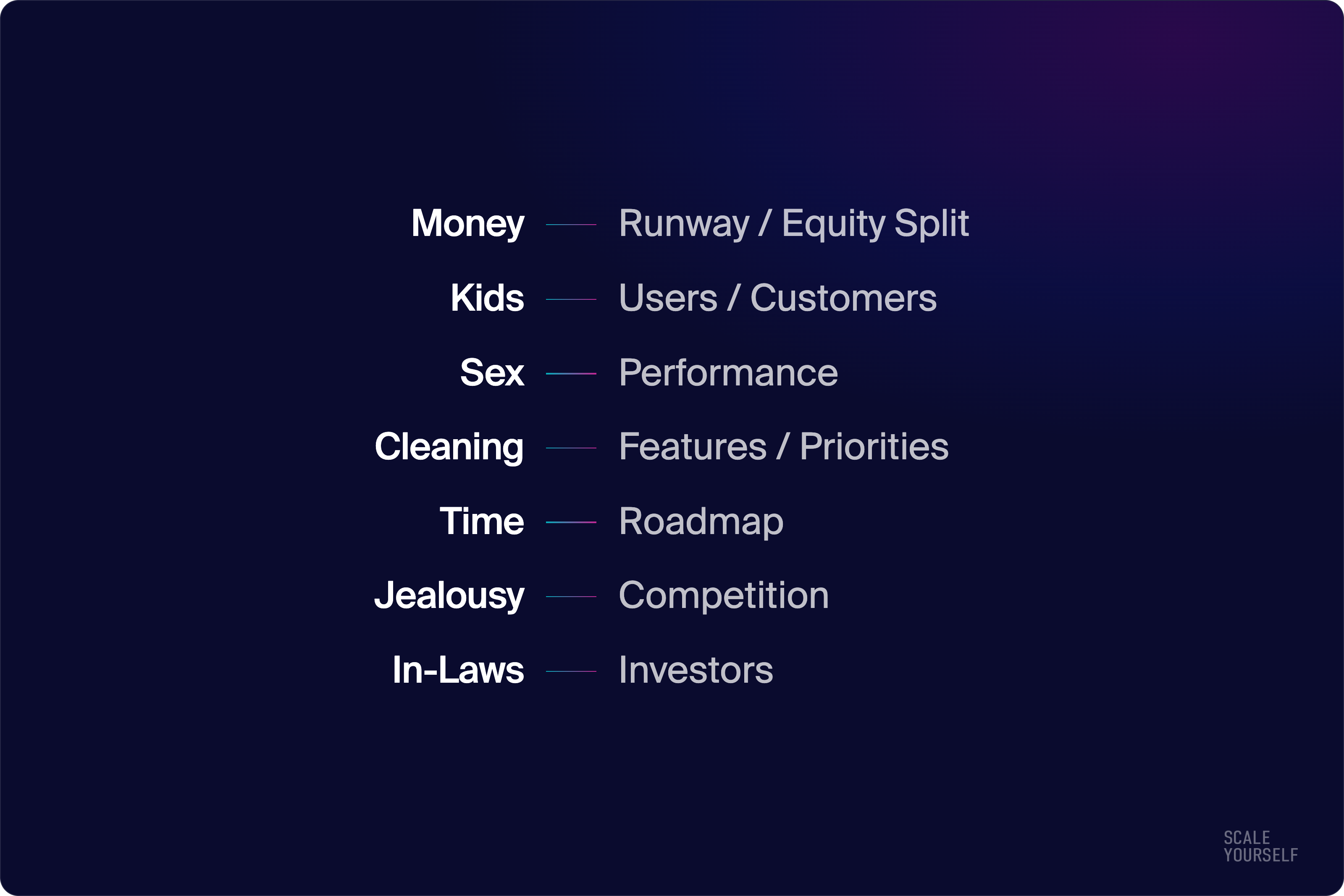
What makes tension dangerous in a startup though, is how it can balloon inside a psychology that’s already afraid. Building a startup means operating within a sustained state of ambiguity and existential fear about whether you’ll be able to build something meaningful before the money runs out. When normal working differences between you and your cofounder get tangled up with that fear, even an expected amount of tension starts to feel like a threat. Tension and fear combine to make your cofounder start to feel like the enemy.
When tension doesn't get talked about, it doesn't go away. Instead, it builds - into feelings, thoughts, assumptions, and judgments that accumulate within you as long as they go unsaid. I call this relationship debt.
For example, let’s say your cofounder has missed a few deadlines. You’ll feel tension starting to build in your body. And you’ll likely think: This is so important - do they not care? They're checked out. How can they not understand how important this is?
Then the heaviness in your belly gets denser and your irritation grows: What are they even focused on? Can I really work with this person for the next ten years? How am I going to be able to fix this?
Over the next few days, you’ll get shorter with them - more critical. You start micromanaging in small ways, or going quiet on threads that have nothing to do with the original problem - but that you’re starting to see as related. Every missed deadline, every slow Slack response goes on the pile — confirming the case that's starting to form in your head about who they are, what this relationship has become, and what that means for your startup.
None of that is the original problem. All of it is relationship debt.
Relationship debt is like technical debt. It’s created when you make choices that feel easier in the moment - staying quiet, avoiding the topic, hoping tension resolves on its own - and it has a lasting negative impact on a relationship if it’s never addressed. Those thoughts, feelings, assumptions, and judgments don’t disappear when the surface-level problem does. They just go quiet. And when tension rises in the relationship again - which it always does - they’ll surface louder than before.
Too much relationship debt erodes trust. It makes small disagreements feel explosive. It can make the relationship feel like it’s failing when what’s actually failed is your management of tension and the pattern you’re living out of never quite saying the true, important thing.
Relationship debt transforms surface-level differences in working style into something bigger, deeper, and much harder to untangle. Relationship debt rusts out the foundation that every early-stage startup is built on: the relationship of the founding team.
And when the founding relationship of an early-stage startup dies, the startup almost always follows.
Most startups die by suicide, not homicide - and relationship debt is why.
Founders scale their relationships when they learn how to use their tension as a signal to initiate what I call a “Level 3 Conversation.” This is the only kind of conversation that relieves relationship debt and builds trust instead of degrading it.
Stay tuned. That’s what the next essay in this series will cover.